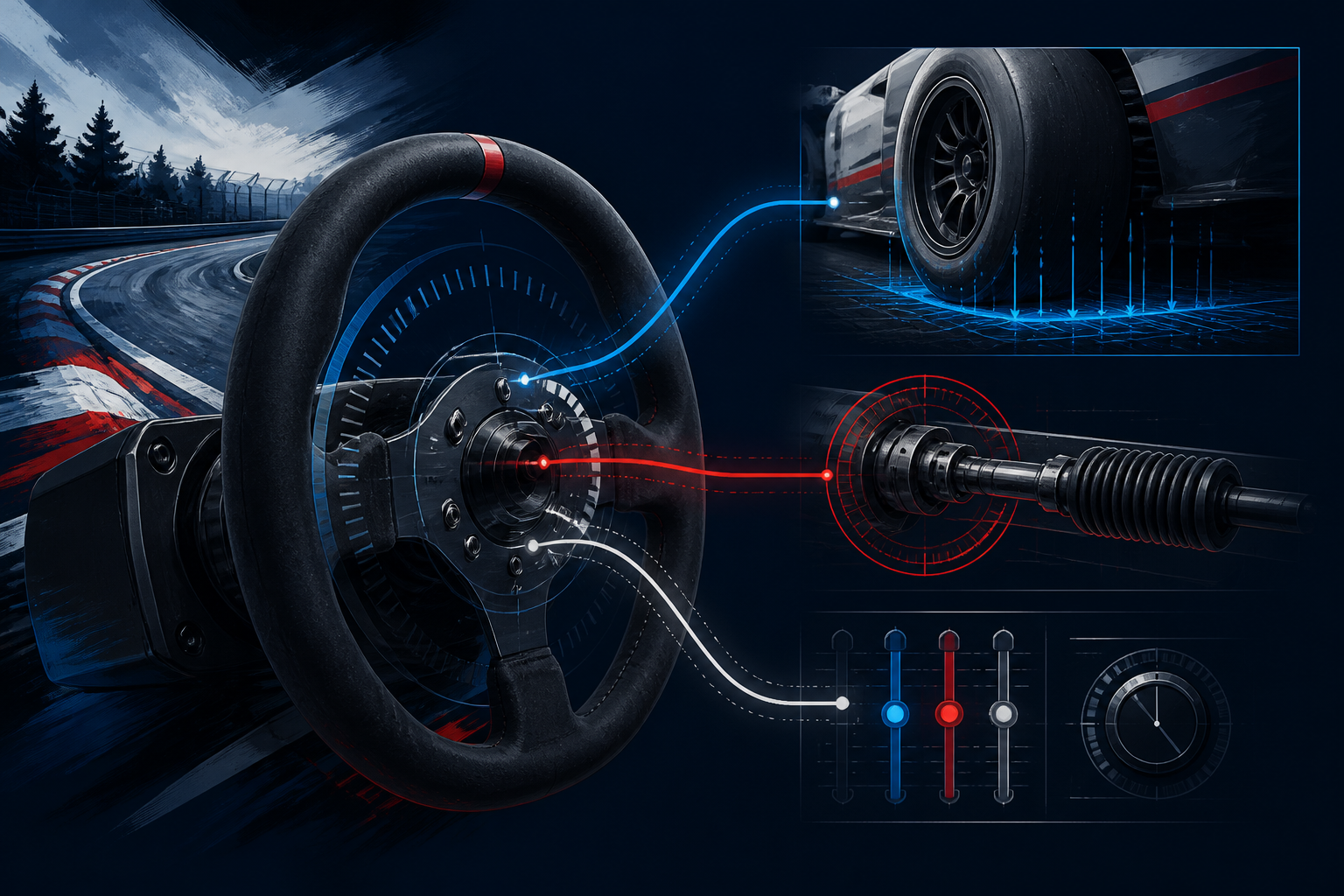

RaceRoom Reworks Force Feedback from Tyres to Steering
A substantial update changes how the simulator calculates and sends wheel feedback, while adding new controls for players.
RaceRoom Racing Experience is making a substantial change to its force-feedback system. In an official Steam News post, the developers describe improvements to tyre contact calculations, a rebuilt power-steering model and new settings for tuning the signal sent to a wheel.
The update is aimed at more than raw strength. Its technical changes focus on how clearly the wheel communicates surface detail, how the signal behaves in corners and how consistently it is delivered under load.
A closer reading of kerbs and contact
The revised tyre contact model accounts for the full shape and movement of the contact patch, evaluating it against the precise polygon shapes the tyre touches. RaceRoom says this should make the handling of complex geometry—including kerb edges and sausage kerbs—more consistent, while also improving two-wheeling and rollover behaviour.
For force feedback, the stated benefit is fewer noisy artifacts caused by difficult geometry and a more precise response to the driving surface. That matters to players trying to read grip and track features through their wheel: detail depends not just on the amount of force, but on how cleanly the simulation represents what the tyres are doing.
Keeping the signal moving
RaceRoom says its physics calculations run at a fixed 400 Hz, using multiple physics ticks in a logic loop when the CPU needs to catch up. Previously, force-feedback output remained tied to the logic-loop rate, which could slow in large grids and degrade both signal quality and response delay.
The developers say they have optimised the logic loop so most systems should maintain 400 Hz in almost any situation. In grids of 100 cars, the rate may still slow slightly, but the post says it should remain fast enough to avoid noticeable force-feedback degradation. The game has also been changed to send feedback through a single DirectInput effect, rather than opening and updating multiple effects—a change RaceRoom says should help wheel compatibility.
More control over the steering feel
A corrected calculation for front-wheel gyroscopic effects removes extra, constant steering weight that the developers say had been drowning out dynamic forces from tyre contact. Because that older effect could also make slides feel more stable, a gyro-effect slider lets players add some of it back. RaceRoom recommends trying the new feel before adjusting it.
The rebuilt power-steering system supports engine-driven hydraulic, electro-hydraulic and fully electric setups. Rather than simply scaling force, it reduces strong, steady cornering loads while allowing fast details and oversteer snaps through. Players can also enable power steering on cars that did not originally have it, which the developers say may help particularly with lower-end wheels.
New smoothing and gyro-damping sliders address different preferences: smoothing filters high-frequency feedback, while gyro damping increases the tyres’ gyroscopic stabilisation to help steady the wheel on straights. Steering rack friction is also modelled across different rack types, and stationary and low-speed feedback is now based on tyre friction and twisting forces rather than a separately added effect.
Why the changes matter
For players, the practical question is whether the revised signal makes it easier to distinguish surface detail from constant steering load—and whether the new controls help adapt the feel to different wheels and cars. The post describes the intended changes, but does not provide comparative measurements or player results.
For streamers and event organisers, clearer, more consistent feedback could be relevant when presenting or standardising a driving setup. The announcement does not specify tournament rules or a required configuration, so the new sliders remain tuning options rather than a confirmed competitive standard.
Newsroom
RaceRoom’s update targets the chain between tyre physics and the wheel: cleaner contact calculations, a more responsive steering model and fewer bottlenecks in feedback delivery. The final feel will depend on how players configure the new options.

Editorial transparency · How this story was created
Original summary generated with artificial intelligence from the official Gaming and technology sources cited in this article.
Language editions may be produced with AI and contain inaccuracies. Original sources remain the reference.
The byline identifies a virtual editorial voice, not a human journalist.
Illustrative cover generated with AI; it is not a photograph documenting the event.
Automated checks are applied. They do not establish human fact-checking.
Published by Ranko Universe. Open an editorial support ticket for corrections or questions.
Sources
-
Big Force Feedback Update
Official source RaceRoom Racing Experience — Steam News · 20/10/2026 10:37
Comments

Preparing the player…

Related Ranko TV videos
No eligible live stream or match right now. Explore Ranko TV.